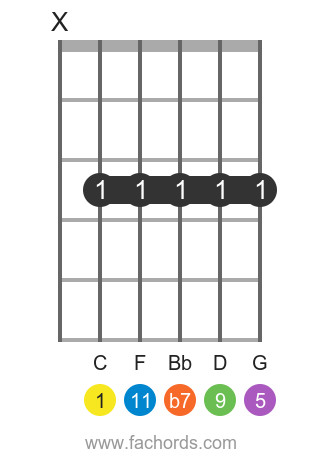
I'm playing with our guitar player's chord chart that for a song that includes a C11 chord. It seemed to me that I should be able to play a C9 (easy chord on steel) but it clashed. When I asked him what he's playing, he said "it's the easiest chord on the guitar" and showed me this position:
To my way of thinking, that's a C9sus4. The low E of my C9 (or C11, or C13) clashes with his F. I need to raise it. So it's really a sus chord, right?
Should I make him change his chart, or just skip the 3rd whenever I see an 11th chord?
(What he's playing sounds right, it's just the chord name that confuses me.)
Location: Central Pennsylvania and Gallatin, Tennessee
State/Province: Pennsylvania
Country: United States
Postby Dave Mudgett »
Yes, technically it's a voicing of the C11 chord. The notes are out of stacked 3rds starting at C, and the b7 and 11 are present, 13 not present. There are several possible names for it - e.g., taking the Bb as root, it's a 2 5 1 3 6 = Bb6/C or 6/2 chord or as Doug states, Gm7/C or m7/11. There's a reasonable spelling as an F chord, although I have a hard time imagining it use it that way in the context of typical popular music. I guess you could call it a D chord too, but it just doesn't sound like a D chord in any context I can think of.
Unless I was playing the exact same chord/voicing, what I would play there would depend on the context, or what the bass player is playing. Could be a C, G, or Bb. If I was playing that as a C chord, I would probably avoid the 3 (E) note altogether - it clashes in any context I can think of when I play it on guitar.
My basic rule - if comping on a complex chord or scale, eliminate notes until it sounds good.
I'd want to know the chord in the measure before and after and what melody notes are in that specific measure with the 11th, unless youre just vamping on that chord...
Jeremy Reeves wrote:I'd want to know the chord in the measure before and after and what melody notes are in that specific measure with the 11th, unless youre just vamping on that chord...
It's a Cm7 before and after. Back and forth. No melody in that section of the song. It eventually resolves through Cm7 Gm7 to EbMaj7 (the song's in Eb).
Jeremy Reeves wrote:I'd want to know the chord in the measure before and after and what melody notes are in that specific measure with the 11th, unless youre just vamping on that chord...
It's a Cm7 before and after. Back and forth. No melody in that section of the song. It eventually resolves through Cm7 Gm7 to EbMaj7 (the song's in Eb).
so it's Contrapuntal Elaboration of Static Harmony
but really just seems like it might be some kind of basic vamp on C-7 with a little variety thrown in. I'd call the chord a C-11 just to make sure no one adds a major 3rd
Cm11 - that would be fine as a clue for improvising over it I suppose. It would certainly keep that dissonant E note out of the mix.
By the way, today I pointed out my dilemma to the band's official scribe - the singer/keyboardist - and she updated the chart as Bb/C which is what she's been playing. That works for me.
Using slash chords in a lot of cases helps arrangers get closer to the sound they want to hear from their chordal instruments. If you see Bb/C in a chart instead of C11, it keys you in to the fact that they want to hear the Bb triad. If it was Bbmin/C, would you prefer to see C11b9? Nope.
Links to streaming music, websites, YouTube: Links
I looked it up using my PG Music Guitar Chord dictionary and it said that is a C9SUS11. It gave several alternate names but I cleared them off to avoid confusing myself.
Harold Fogle (1945-1999) Pedal Steel Player
Dell desktop i7, 256 C drive, 4TB storage
2026 BiaB UltraPlus PAK
Cakewalk Sonar Free software DAW
Zoom MRS-8 hardware DAW
C9sus#11?
odd way to label it and incorrect since there is no #11 (raised fourth/flatted fifth). Bb/C isn't quite right either since the G note is included. Gm7/C or C9sus4 is most accurate
Location: Central Pennsylvania and Gallatin, Tennessee
State/Province: Pennsylvania
Country: United States
Postby Dave Mudgett »
C9sus#11 is just wrong. There's no #11 in this chord rooted in C.
I agree with Mike that I'd prefer to see slash chords than some 'technically correct' 11th chord notation because the latter doesn't tell you two critical things: 1. the bottom note/inversion, and 2. what interval(s) are missing. This chord has all of the 1,3,5, and 6 intervals in the key of Bb, so Bb6/C is entirely accurate and pretty unambiguous except for the exact order of the notes.
As far as my general preference of exactly which root to choose, I would generally defer to how the chord is being used in context, so that I'm on the right track when I (frequently) eliminate notes when comping.
I think it's a Gm7/C in this context. Our band's scribe changed the C11 to Bb/C and I'm okay with her decision. Makes it easy to find anywhere on the neck. C11 is harder and, more importantly, it was the wrong chord.
Dave: PG Music has some strange ideas about chord names in BIAB as well. I don't trust them.