All of the textbook explanations of the overtone series that I have seen only include those overtones which occur in the first four octaves.
Does anyone know of a table that lists higher overtones, or is it possible to just use a few general principles and extrapolate them?
Thanks,
Jeff S.
Overtone Series
Moderator: Dave Mudgett
-
Jeff A. Smith
- Posts: 807
- Joined: 14 Feb 2001 1:01 am
- Location: Angola,Ind. U.S.A.
- State/Province: -
- Country: United States
-
Earnest Bovine

- Posts: 8369
- Joined: 4 Aug 1998 11:00 pm
- Location: Los Angeles CA USA
- State/Province: -
- Country: United States
-
chas smith R.I.P.

- Posts: 5043
- Joined: 28 Feb 2001 1:01 am
- Location: Encino, CA, USA
- State/Province: -
- Country: United States
The table is whole numbers out to infinity. The reason you usually see only 4 octaves, out to the 16th, is because it's easy to relate them to the 12 tones on the piano, even though there are slight differences. Twelve tone octaves, diatonic harmonies and 4/4 time is the realm of Western man, and our point of referance. The further out you go, with the harmonic series, the more microtonal it gets and it takes a different mindset to relate to them.<FONT SIZE=1 COLOR="#8e236b"><p align=CENTER>[This message was edited by chas smith on 20 January 2003 at 03:30 PM.]</p></FONT><SMALL>Does anyone know of a table that lists higher overtones, or is it possible to just use a few general principles and extrapolate them? </SMALL>
-
Jeff A. Smith
- Posts: 807
- Joined: 14 Feb 2001 1:01 am
- Location: Angola,Ind. U.S.A.
- State/Province: -
- Country: United States
Well, that's helpful. I wondered why there seems to be this arbitrary cut-off point.<SMALL>The reason you usually see only 4 octaves, out to the 16th, is because it's easy to relate them to the 12 tones on the piano, even though there are slight differences. </SMALL>
Would I be correct in assuming that: Not allowing for inharmonicity in the medium, someone could take all of the prime numbers as basic reference partials, calculate octaves from them, and potentially cover all of the overtones?
Another question: it's easy to visualize how a string breaks up this way, but I don't have a pictorial handle on how this process happens with wind instruments. Is it possible to describe this?
One last thing- It seems like one of those really far out things, that physical mediums obey some law by which they MUST break up into whole number partials; and then that they continue to do this indefinitely. It's as if in lieu of a knowledge of numbers, someone could've observed the behavior of a string and invented all the whole numbers for the first time. Maybe it's really not as amazing as it seems to me at present, but I can see why Pythagoras and others thought that numbers represented much more than a practical system for getting by in the world.
Thanks for the comments.
-
Earnest Bovine
- Posts: 8369
- Joined: 4 Aug 1998 11:00 pm
- Location: Los Angeles CA USA
- State/Province: -
- Country: United States
There is no magic in why a string or an air column tends to vibrate at a certain fundamental frequency at at integer multiples of that frequency .
It happens because waves reflect, bouncing back from the ends of a string or an air column (tube of air such as a trumpet or flute). Waves travel at a certain velocity: in air we call it the speed of sound, and along a string it depends on mass and tension of the string.
Consider a tube whose length is the distance that a sound wave travels in .001 second (approx a 9-inch tube). If you excite (shake) the air at exactly 1000 times per second (1000 Hz), the wave that is reflected from the end will be in phase with the next wave, and the next, and so on and they will reinforce one another. But if you excite the air at 900 times per second, the reflected wave will not line up with the next wave, and they will tend to cancel each other. In fact, you won't be able to make the tube vibrate at 900 Hz.
Now what if you excite the air at 2000 Hz? Draw the wave forms and you can see that again the reflected waves will reinforce each other. Same thing happens at 3000, 4000, etc. A tube is long enough to hold exactly one fundamental wavelength, on exactly two, or exactly three, etc.
It's a lot easier to see with a picture. Maybe somebody has an Internet link to a good illustration.
Waves in air are longitudinal (along the direction or propagation or wave travel) while waves in strings and the surface of water are transverse (perpendicular to propagation) yet most of these same principles apply equally to both kinds of waves.
Differences occur in the way they are reflected at the ends of the tube. The end of a string is a node, meaning a place where the string doesn't move. At twice the frequncy (half the wavelength) there is a node in the middle of the string. You know this from making harmonics on the steel.
The same is true with most air columns (all brass instruments, flutes, double reeds, and single reeds with conical bore such as the saxophone). But single reeds with cylindrical bore, meaning constant diameter, reflect at an anitnode and cannot vibrate at even-numbered multiples of the fundamental. They can only vibrate at 1x, 3x, 5x, 7x, etc. That's why the you go up and octave plus a fifth when you hit the "octave" key on a clarinet, but only an octave on a sax.
It happens because waves reflect, bouncing back from the ends of a string or an air column (tube of air such as a trumpet or flute). Waves travel at a certain velocity: in air we call it the speed of sound, and along a string it depends on mass and tension of the string.
Consider a tube whose length is the distance that a sound wave travels in .001 second (approx a 9-inch tube). If you excite (shake) the air at exactly 1000 times per second (1000 Hz), the wave that is reflected from the end will be in phase with the next wave, and the next, and so on and they will reinforce one another. But if you excite the air at 900 times per second, the reflected wave will not line up with the next wave, and they will tend to cancel each other. In fact, you won't be able to make the tube vibrate at 900 Hz.
Now what if you excite the air at 2000 Hz? Draw the wave forms and you can see that again the reflected waves will reinforce each other. Same thing happens at 3000, 4000, etc. A tube is long enough to hold exactly one fundamental wavelength, on exactly two, or exactly three, etc.
It's a lot easier to see with a picture. Maybe somebody has an Internet link to a good illustration.
Waves in air are longitudinal (along the direction or propagation or wave travel) while waves in strings and the surface of water are transverse (perpendicular to propagation) yet most of these same principles apply equally to both kinds of waves.
Differences occur in the way they are reflected at the ends of the tube. The end of a string is a node, meaning a place where the string doesn't move. At twice the frequncy (half the wavelength) there is a node in the middle of the string. You know this from making harmonics on the steel.
The same is true with most air columns (all brass instruments, flutes, double reeds, and single reeds with conical bore such as the saxophone). But single reeds with cylindrical bore, meaning constant diameter, reflect at an anitnode and cannot vibrate at even-numbered multiples of the fundamental. They can only vibrate at 1x, 3x, 5x, 7x, etc. That's why the you go up and octave plus a fifth when you hit the "octave" key on a clarinet, but only an octave on a sax.
-
chas smith R.I.P.
- Posts: 5043
- Joined: 28 Feb 2001 1:01 am
- Location: Encino, CA, USA
- State/Province: -
- Country: United States
I'm not sure what you mean by basic reference partials, but all octaves are 2/1, and multiples of 2, of any number. The octaves calculated from primes, such as 1, 2, 3, 5, 7, 11, 13, 17, 19, will cover a lot of territory, but even with this group, we're missing 9, 15 and 18. If you want to cover all the overtones, it's whole numbers out to infinity.<SMALL>Would I be correct in assuming that: Not allowing for inharmonicity in the medium, someone could take all of the prime numbers as basic reference partials, calculate octaves from them, and potentially cover all of the overtones?</SMALL>
Sound is mechanical energy, and it travels at around 1100 feet/sec. So one cycle of a 110hz tone, that is A below A below middle C, is 10 feet long. The ideal tube that supports the column of air to make a 110hz tone would be 10' long, actually it only needs to be 5' because it only has to be a half a wave length...it looks like Doug has this one covered above.<SMALL>Another question: it's easy to visualize how a string breaks up this way, but I don't have a pictorial handle on how this process happens with wind instruments. Is it possible to describe this?</SMALL>
Well briefly, numbers have traditionally represented much more than a practical system for getting by in the world. They were and still are used to describe the universe we live in. For example, 20th/21st century man sees himself at the forefront of time with time extending behind him as history, whereas medieval man saw himself as part of a continuum and some of the things in that continuum were represented by small numbers. Like 1, God; 2, the union of heaven and earth; 3, the Trinity, whether the Father , Son and Holy Ghost, or Zeus, Posiedon and Hades, or Osirus, Isis and Horus; 4, the Earth, North South East and West; 5, man, two arms, two legs and one head; 7, the Trinity and the Earth;....And unless I'm mistaken, the intervals of the planets from the sun follow the fibonacci series. All of this was just a small part of the numerology of the time.<SMALL>that physical mediums obey some law by which they MUST break up into whole number partials; and then that they continue to do this indefinitely. It's as if in lieu of a knowledge of numbers, someone could've observed the behavior of a string and invented all the whole numbers for the first time. Maybe it's really not as amazing as it seems to me at present, but I can see why Pythagoras and others thought that numbers represented much more than a practical system for getting by in the world.</SMALL>
And because numbers represented the intervals of the harmonic series, which were harmonious, that was a proof of the harmony in the universe. Also the ratios of the harmonics were used in building some of the churches as ratios for the floor plans and shapes which gave rise to the phrase that architecture is "frozen music".
"that physical mediums obey some law by which they MUST break up into whole number partials"
The physical mediums were there long before we invented the number systems we use to describe them and if you think about it, those number systems are in themselves abstactions, that we agree on. So we're using abstactions to describe the universe. When I look at the formulas, which I don't understand, that are used to describe phenomena, the phenomena makes more sense to me then a blackboard full of scribbles.
This could turn into a dissertation.....<FONT SIZE=1 COLOR="#8e236b"><p align=CENTER>[This message was edited by chas smith on 22 January 2003 at 12:28 AM.]</p></FONT>
-
Dave Boothroyd

- Posts: 902
- Joined: 30 Oct 1999 12:01 am
- Location: Staffordshire Moorlands
- State/Province: -
- Country: United States
If you do any work with additive synthesis, you rapidly come to the conclusion that for a tone to sound interesting, you need to include overtones (harmonics) well beyond the fourth octave. Actually you need to go well up to the top of audio range and beyond.
That is true even when you are only using whole number harmonics.
It actually gets a bit more complicated with guitars.
Normally a string instrument can only create harmonics in a whole number relationship to the fundamental frequency. This is because the ends of the string are fixed to a bridge or a top nut. So they cannot move and the string can only vibrate in a way that divides the length into an exact number of parts. There is nothing mystical about this- except that it is a fundamental part of the structure of a three dimensional universe. This is pretty much the case for a steel guitar, but it's not true for an acoustic or a resonator. On these the bridge can move and the neck flexes, so the ends of the string are not completely fixed, so these guitars can, and do, produce harmonics which are not whole-number multiples of the fundamental.
Whether these harmonics sound good or not depends on the musicality of the flex. That is why we spend money on special spiders and cones for resonators, or top quality timbers for guitars, or why many people prefer bakelite to wood as a material for a lap steel.
Cheers
Dave <FONT SIZE=1 COLOR="#8e236b"><p align=CENTER>[This message was edited by Dave Boothroyd on 22 January 2003 at 04:13 AM.]</p></FONT><FONT SIZE=1 COLOR="#8e236b"><p align=CENTER>[This message was edited by Dave Boothroyd on 22 January 2003 at 04:21 AM.]</p></FONT>
That is true even when you are only using whole number harmonics.
It actually gets a bit more complicated with guitars.
Normally a string instrument can only create harmonics in a whole number relationship to the fundamental frequency. This is because the ends of the string are fixed to a bridge or a top nut. So they cannot move and the string can only vibrate in a way that divides the length into an exact number of parts. There is nothing mystical about this- except that it is a fundamental part of the structure of a three dimensional universe. This is pretty much the case for a steel guitar, but it's not true for an acoustic or a resonator. On these the bridge can move and the neck flexes, so the ends of the string are not completely fixed, so these guitars can, and do, produce harmonics which are not whole-number multiples of the fundamental.
Whether these harmonics sound good or not depends on the musicality of the flex. That is why we spend money on special spiders and cones for resonators, or top quality timbers for guitars, or why many people prefer bakelite to wood as a material for a lap steel.
Cheers
Dave <FONT SIZE=1 COLOR="#8e236b"><p align=CENTER>[This message was edited by Dave Boothroyd on 22 January 2003 at 04:13 AM.]</p></FONT><FONT SIZE=1 COLOR="#8e236b"><p align=CENTER>[This message was edited by Dave Boothroyd on 22 January 2003 at 04:21 AM.]</p></FONT>
-
Jeff A. Smith
- Posts: 807
- Joined: 14 Feb 2001 1:01 am
- Location: Angola,Ind. U.S.A.
- State/Province: -
- Country: United States
Right you are. In my mind I saw 9 and 15 as multiples of three, but didn't fully realize I wasn't thinking of octaves anymore. Maybe a better way of saying what I had in mind would be that each prime number partial needs to be divided up just like the original fundamental. But, as you seem to be saying; if one wants to calculate these, it is best to just think whole numbers outto infinity.<SMALL>The octaves calculated from primes, such as 1, 2, 3, 5, 7, 11, 13, 17, 19, will cover a lot of territory, but even with this group, we're missing 9, 15 and 18. </SMALL>
In practical terms, is an infinity of overtones possible as anything other than a mathematical abstraction?
Earnest(Doug), thank you for the excellent description of vibrations in wind instruments. It's still kind of tough, though, to imagine longitudinal waves breaking up into infinitely small sections. Maybe I can find a picture somewhere of lower overtones doing this.
Messing around with electronic keyboards or organs, I can at least hear more basic beat rates when playing intervals together. However, I have read that the overtone structure is much simpler on electronic keyboards, and this is one thing that acoustic instruments have over them. Is this pretty much accurate?
Chas, (or anyone)how much do you know about the notes in Indian music? Is Indian music (or other non-Western forms) based more on the overtone series?
Thanks, and desertations are appreciated.
-
chas smith R.I.P.
- Posts: 5043
- Joined: 28 Feb 2001 1:01 am
- Location: Encino, CA, USA
- State/Province: -
- Country: United States
About all I remember about North Indian music is the octave is divided into 22 parts called srutis, and it's not tempered. Here's a link:
http://sonic-arts.org/monzo/indian/indian.htm
http://sonic-arts.org/monzo/indian/indian.htm
In an electronic instrument, the harmonics, sine tones, are generated electronically, duh!, anyway, that means they are all perfectly in tune (and lifeless) as opposed to the imperfections of naturally occuring sounds. There was another thread somewhere where I was talking about this recently, and I gave the "world according to chas" version.<SMALL> I have read that the overtone structure is much simpler on electronic keyboards, and this is one thing that acoustic instruments have over them. </SMALL>
-
Dave Boothroyd
- Posts: 902
- Joined: 30 Oct 1999 12:01 am
- Location: Staffordshire Moorlands
- State/Province: -
- Country: United States
You are a little behind the times on synthesis Chas.(about 20 years actually) Subtractive Synths use square and sawtooth waves and filters to control harmonics, but there are a dozen different types of synth since those days. Until the dance music people started reviving a digital simulation of the old analogue synths, most keyboards play actual sampled instrument waveforms, but there is also FM synthesis, Physical Modelling, granular synthesis, and software synths which can do all of those at once.
If a modern synth sounds are dull for you, you need to use a better synth- it is only on the accurate reproduction of playing quirks that they let you down. The very large majority of film music which appears to be orchestral is synthesised- if the budget runs to it they will often have the lead parts of the score played on real instruments, but the rest is out of a box.
Cheers
Dave
If a modern synth sounds are dull for you, you need to use a better synth- it is only on the accurate reproduction of playing quirks that they let you down. The very large majority of film music which appears to be orchestral is synthesised- if the budget runs to it they will often have the lead parts of the score played on real instruments, but the rest is out of a box.
Cheers
Dave
-
Jeff A. Smith
- Posts: 807
- Joined: 14 Feb 2001 1:01 am
- Location: Angola,Ind. U.S.A.
- State/Province: -
- Country: United States
I'll check around and see what else has been said on here about electronic keyboards and overones. Dave, thanks for the input.
Chas, I notice that you described Northern Indian music as having 22 basic tones. You're probably aware that the southern "Karnatic" style has roughly twice as many notes. I was talking once to a young Indian who specialized in that style, and what he said wasn't always easy to follow. It almost sounded like the difference between some of the notes was more psychological than anything. I guess I'm kind of interested in how ancient cultures standardized their music.
I have seen, at least once, a group of Indian scales listed that were analogous to our modes. Perhaps there was some cross-talk at some point. I don't know when the Indians became aware of those scales, either. Maybe it was fairly recently.
Back to the way the overtone series breaks down: It seems to me likely that the higher overtones derive their vibration in a heirarchic fashion from the lower overtones that they are multiples of: I am speculating that all harmonics above the fundamental derive their vibration downward, eventually from a prime number partial, and then directly from the fundamental. My speculation is that perhaps the prime number partials are independent of each other, deriving their vibration only from the fundamental, (at least pretty much), while acting as parents for all higher overtones mathematically dependent upon them. If these seems off in some way, please correct me.
Thanks,
Jeff
Chas, I notice that you described Northern Indian music as having 22 basic tones. You're probably aware that the southern "Karnatic" style has roughly twice as many notes. I was talking once to a young Indian who specialized in that style, and what he said wasn't always easy to follow. It almost sounded like the difference between some of the notes was more psychological than anything. I guess I'm kind of interested in how ancient cultures standardized their music.
I have seen, at least once, a group of Indian scales listed that were analogous to our modes. Perhaps there was some cross-talk at some point. I don't know when the Indians became aware of those scales, either. Maybe it was fairly recently.
Back to the way the overtone series breaks down: It seems to me likely that the higher overtones derive their vibration in a heirarchic fashion from the lower overtones that they are multiples of: I am speculating that all harmonics above the fundamental derive their vibration downward, eventually from a prime number partial, and then directly from the fundamental. My speculation is that perhaps the prime number partials are independent of each other, deriving their vibration only from the fundamental, (at least pretty much), while acting as parents for all higher overtones mathematically dependent upon them. If these seems off in some way, please correct me.
Thanks,
Jeff
-
chas smith R.I.P.
- Posts: 5043
- Joined: 28 Feb 2001 1:01 am
- Location: Encino, CA, USA
- State/Province: -
- Country: United States
Well that could be. I started on a Buchla 200, 30 years ago,and I still have my Serge, I also have an EIV, Absynth, Reaktor and Giga Studio.<SMALL>You are a little behind the times on synthesis Chas.(about 20 years actually) </SMALL>
Sampled waveforms and wavetables are not creating electrically generated harmonics in the same way an oscillator does, they are functioning as playback. Jeff's question addressed electronic keyboards and organs. I took that as a question about the differences between oscillator harmonics vs naturally occuring harmonics. Granular sythesis is a digital manipulation process of an existing waveform. Frequency modulated oscillators create overtone structures from the sidebands, I don't remember the math and it's more complicated than I wanted to get into here, perhaps you would be willing to address it.<SMALL>most keyboards play actual sampled instrument waveforms, but there is also FM synthesis, Physical Modelling, granular synthesis, and software synths which can do all of those at once.If a modern synth sounds are dull for you, you need to use a better synth- it is only on the accurate reproduction of playing quirks that they let you down. </SMALL>
I actually have some experience here.<SMALL>The very large majority of film music which appears to be orchestral is synthesised- if the budget runs to it they will often have the lead parts of the score played on real instruments, but the rest is out of a box.</SMALL>
Cheers
Chas
-
Bobby Lee

- Site Admin
- Posts: 14863
- Joined: 4 Aug 1998 11:00 pm
- Location: Cloverdale, California, USA
- State/Province: -
- Country: United States
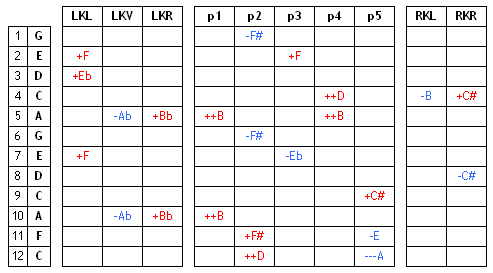
Chas, that Indian link is very enlightening. I always wondered why Indian music didn't sound stranger than it does. The chart makes it clear than 20 of the notes are grouped into pairs that are, in fact, very close to the notes in our 12-tone scale.
Thanks!
------------------
<small><img align=right src="http://b0b.com/b0b.gif" width="64" height="64">Bobby Lee - email: quasar@b0b.com - gigs - CDs
Sierra Session 12 (E9), Williams 400X (Emaj9, D6), Sierra Olympic 12 (C6add9), Sierra Laptop 8 (D13), Fender Stringmaster (E13, A6), Roland Handsonic, Line6 Variax (coming soon)
Thanks!
------------------
<small><img align=right src="http://b0b.com/b0b.gif" width="64" height="64">Bobby Lee - email: quasar@b0b.com - gigs - CDs

Sierra Session 12 (E9), Williams 400X (Emaj9, D6), Sierra Olympic 12 (C6add9), Sierra Laptop 8 (D13), Fender Stringmaster (E13, A6), Roland Handsonic, Line6 Variax (coming soon)
-
chas smith R.I.P.
- Posts: 5043
- Joined: 28 Feb 2001 1:01 am
- Location: Encino, CA, USA
- State/Province: -
- Country: United States
The heirarchy is they are all generated by the fundamental.<SMALL>Back to the way the overtone series breaks down: It seems to me likely that the higher overtones derive their vibration in a heirarchic fashion from the lower overtones that they are multiples of:</SMALL>
Jeff, this is what I answered to a queation about Just Intonation , in another thread:
<BLOCKQUOTE><font size="1" face="Verdana, Arial, Helvetica">quote:</font><HR><SMALL>Just Intonation is derived from the relationships (intervals) of the various harmonics in the harmonic series to the fundamental, (which is the note that you played). Essentially, all natural sounds have the same harmonic series, that is, the relationahips are always the same. What changes is, each harmonics relative loudness to the other harmonics when the note is played. Their relative loudness (amplitudes) is what gives that instrument/thing it's individual sound.
The harmonics are numbered sequentially, 1, 2, 3, 4, 5, 6, 7...out to infinity,and mathematically, this also is what their frequency is relative to the fundamental, the first harmonic. So if you are sitting at the piano, and you were to play C below C below middle C, middle C is 261.6hz, the C an octave below that is 130.8hz and the C below that is 65.4hz. Looking above, if the fundamental is C 65.4hz, and the 2nd harmonic is 2/1 (an octave above), it's C 130.8hz. An octave above the 2 would be the 4, 4/2 = 2/1 and that would be middle C, 261.6hz. The 8th and the 16th are also C.
The 3rd harmonic is a G, 196.2hz as is the 6th, 392.4hz, and the 12th and the 24th.
The 5th is an E, 327hz, as is the 10th. The 7th is a Bb, 457.8hz, the 9th is a D, 588.6hz, the 11th is an F#, 719.4hz, the 13th is an A, 850.2hz and the 15th is a B natural, 981hz.
If you're still with me, you may have noticed that the A is 850.2 and not A 880, as it is on the piano. This is because, the harmonic series relates to/is generated by the fundamental and each fundamental has it's own harmonic series.
Also, on the piano, the E, above middle C, will be 329.6 and not 327. this is why the 3rds and 6ths are tuned flat from ET to tune out the beats on your guitar.
Perhaps you've seen the fractions (small number ratios) 1/1, 16/15, 9/8, 6/5, 5/4, 4/3, 45/32, 3/2, 8/5, 5/3, 16/9, 15/8, 2/1 used to describe one of the Just scales. As you know, intervals are distances, a 5th is the distance
between say a C and G and in the above series, there is a G at the 3rd harmonic and the C below that is the 2nd harmonic. So G/C is 3/2 and that's the "normal" Just 5th. The distance between the 3rd and the 4th is a P4th, C/G, 4/3. The 5th har. is an E and the 4th is a C so this E/C is the 5/4 maj 3rd. The distance between the 6th, G and the 5th E is a minor 3rd, G/E, 6/5.
There is a minor 6th between the 8th and the 5th, C/E, 8/5 and a maj 6th between the 5th, E and the 3rd, G, E/G, 5/3. 16/9 is a b7, 15/8 is a maj7, 16/15 is C/B, a minor 2nd and the just tritone is usually 45/32 although 7/5 and 10/7 are available.
Now, there are maj 2nds between 13/12, 11/10, 10/9, 9/8 and 8/7 (out to the 16th harmonic, remember, these things keep on going). Each one is different, although not by much, so we normally pick the 9/8, which is perfectly in
tune with the 3/2 (notice how 9/8 can be reduced to 3/2). It is not in tune with the 5/3 A, so the "traditional" just scale also includes the 10/9 maj 2nd, that's right two maj 2nds in one scale, notice that 10/9 can be reduced to 5/3, that's how you know they'll be in tune.
A flute sound will be mostly even harmonics, 2, 4 and 8, a clarinet has a more raspy sound and that's because it has a lot of odd harmonics 3, 5, 7, 9...
If you want to tune in just with the Peterson, tune your roots and 5ths straight up. (The tempered 5th is really close to the Just 5th, G above middle C is 391.95 Tempered and 392.4 Just) and then I tune the 3rds and 6ths approx 15
cents flat and after that, everything else is a compromise,(the reason for equal temperment in the first place).</SMALL><HR></BLOCKQUOTE>
-
Jeff A. Smith
- Posts: 807
- Joined: 14 Feb 2001 1:01 am
- Location: Angola,Ind. U.S.A.
- State/Province: -
- Country: United States
Thanks for pasting the section from the other thread, Chas. Now I can print all this off in one segment. I think the thing that has thrown my understanding on how the vibrating string divides up, is that I hadn't really grasped until now what Earnest said above: <BLOCKQUOTE><font size="1" face="Verdana, Arial, Helvetica">quote:</font><HR><SMALL>There is no magic in why a string or an air column tends to vibrate at a certain fundamental frequency at at integer multiples of that frequency .
It happens because waves reflect, bouncing back from the ends of a string </SMALL><HR></BLOCKQUOTE> The fact that the breaking down into partials happens as the string vibrates LENGTHWISE shifts my perspective dramatically. My idea of a "heirarchy" was hatched because I still clung to the idea that it was the string's vertical vibrations that somehow caused the breaking up. If I'm still skewing this somehow, I'd appreciate a correction. Thanks for your patience.
Jeff
It happens because waves reflect, bouncing back from the ends of a string </SMALL><HR></BLOCKQUOTE> The fact that the breaking down into partials happens as the string vibrates LENGTHWISE shifts my perspective dramatically. My idea of a "heirarchy" was hatched because I still clung to the idea that it was the string's vertical vibrations that somehow caused the breaking up. If I'm still skewing this somehow, I'd appreciate a correction. Thanks for your patience.
Jeff
-
chas smith R.I.P.
- Posts: 5043
- Joined: 28 Feb 2001 1:01 am
- Location: Encino, CA, USA
- State/Province: -
- Country: United States
First, I found this article on FM music synthesis that mentions and gives credit to John Chowning, who taught at Stanford:
http://www.sfu.ca/~truax/fmtut.html
Vibrating things are really complex which is why the sounds they make are complex and why it is so difficult to reproduce them electronically. Not only is the vibration complex, but it is changing/evolving from the moment it's first initiated, blown, struck, bowed or plucked to the end of its decay. So the harmonics present at the beginning of the waveform, the ictus, are different from the later stages.
As Doug noted, not only is the string going up and down and round and round it's going end to end. When a piano string is struck by the hammer, it makes a "Z" that runs up and down the string in addition to everything else.
The physics guys can tell you a lot more than I can about this stuff.
http://www.sfu.ca/~truax/fmtut.html
Vibrating things are really complex which is why the sounds they make are complex and why it is so difficult to reproduce them electronically. Not only is the vibration complex, but it is changing/evolving from the moment it's first initiated, blown, struck, bowed or plucked to the end of its decay. So the harmonics present at the beginning of the waveform, the ictus, are different from the later stages.
As Doug noted, not only is the string going up and down and round and round it's going end to end. When a piano string is struck by the hammer, it makes a "Z" that runs up and down the string in addition to everything else.
The physics guys can tell you a lot more than I can about this stuff.
-
Earnest Bovine
- Posts: 8369
- Joined: 4 Aug 1998 11:00 pm
- Location: Los Angeles CA USA
- State/Province: -
- Country: United States
Chas
I was ignoring all that complicated stuff.
The reason that standing waves occur at only 1,2,3,4,5,6 etc times a fundamental frequency is that a string can vibrate only at wavelengths of 1/1, 1/2, 1/3, 1/4, 1/5, 1/6 etc of its total length. This is because the ends can't move, and there can also be other places in the string that don't move ("nodes").
Half the wavelength means twice the frequency, etc.
I just tried a Google search on "standing wave" illustration and got these which may help: http://hyperphysics.phy-astr.gsu.edu/hbase/waves/string.html http://www.gilroyphysics.net/Honors_Physics/handouts/H10_waves/H1006_standing_waves/H1006W.html
The 2nd one shows how you get a "standing" wave when you add together a right-moving wave and a left-moving wave, as you would get in a string where the wave bounces (reflects) off the rigid ends.
I was ignoring all that complicated stuff.
The reason that standing waves occur at only 1,2,3,4,5,6 etc times a fundamental frequency is that a string can vibrate only at wavelengths of 1/1, 1/2, 1/3, 1/4, 1/5, 1/6 etc of its total length. This is because the ends can't move, and there can also be other places in the string that don't move ("nodes").
Half the wavelength means twice the frequency, etc.
I just tried a Google search on "standing wave" illustration and got these which may help: http://hyperphysics.phy-astr.gsu.edu/hbase/waves/string.html http://www.gilroyphysics.net/Honors_Physics/handouts/H10_waves/H1006_standing_waves/H1006W.html
The 2nd one shows how you get a "standing" wave when you add together a right-moving wave and a left-moving wave, as you would get in a string where the wave bounces (reflects) off the rigid ends.